

Helen Rantsevitch
Is Critical Thinking the New Coding?
Is Critical Thinking the New Coding?
Helen Rantsevitch
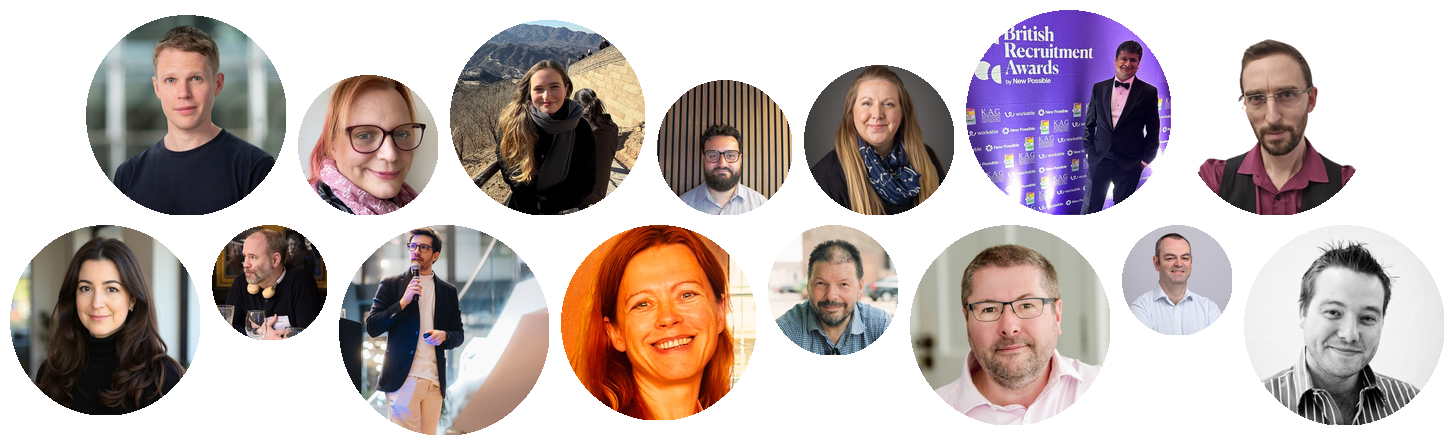
Written by 15 humans who code, teach coding or hire to code
When Kant wrote his essay What Is Enlightenment? in 1784, he observed that most humans were content to defer their thinking to anyone willing to spare them the effort of reasoning for themselves. Pastors, doctors, and authorities served as a pro subscription to a single source of truth. This self-imposed immaturity, he argued, stemmed less from a lack of intellect than from a lack of courage to use one's own understanding without guidance.
Do we Dare to Know (Sapere Aude) now and how does this motto of Enlightenment echo in the AI context?
While critical inquiry began as a search for truth, contemporary inquiry increasingly asks how reality itself becomes knowable through the interaction of observer, perspective, context, and systems – and does it?
This article explores a hypothesis: If coding defined the internet age, critical thinking will become the defining skill of the AI age.
I invited CTOs, educators, and talent experts to spar on the emerging trends. Apparently, there is no consensus in the kingdom of tech, which made the exercise all the more interesting.
As a preamble, allow me to bring the definitions, observations, and hard facts. So, what is critical thinking? Definitions vary. “Critical thinking is the process of thinking carefully about a subject or idea, without allowing feelings or opinions to affect you.” (Cambridge English Dictionary).
“Critical thinking is, in short, self-directed, self-disciplined, self-monitored, and self-corrective thinking. It presupposes assent to rigorous standards of excellence and mindful command of their use. It entails effective communication and problem solving abilities and a commitment to overcome our native egocentrism and sociocentrism.” Source:(Richard Paul and Linda Elder, The Miniature Guide to Critical Thinking Concepts and Tools, Foundation for Critical Thinking Press, 2008)
Is there a Relational Turn in Critical Inquiry?
Critical inquiry traces its roots to the Socratic practice of questioning assumptions and examining beliefs through dialogue. It served as cognitive infrastructure for citizens who would be voting on war, taxation, and justice, while being constantly swayed by demagogues. Apparently, the Greeks needed stronger reason and evidence to discern a world governed by myth and authority.
During the Enlightenment, the implicit metaphor was the machine – objective reality, the detached observer, linear causality, and reductionist analysis. Its classical form was concerned primarily with the validity of claims:
How do I know whether this claim is true?
Although critical thinking already contained dialogical and perspectival elements, the task was to separate knowledge from opinion through logic, evidence, and rational scrutiny.
The emerging worldview takes into account the increasing complexity and is closer to the metaphor of a relational field: observer participation, interdependence, uncertainty, and multiple situated perspectives.
The inquiry therefore turns towards the frame itself, asking:
What can be known, by whom, from which perspective, under what conditions, and with what consequences?
This relational, participatory view finds interesting resonance with insights drawn from quantum mechanics theory. Treated as heuristics, they open an interesting angle on both relational dynamics and the emerging role of AI as a new kind of observer.
These insights are purely provocative and aim to question the source of context in AI reasoning, whether AI has any relationships, and whether uncertainty exists in its algorithmic reality:
1. Observer and Observed Are Entangled
Critical thinking evolves from evaluating objects to examining the interaction between observer and observed. The questions, frameworks, and methods we bring shape what becomes knowable.
2. Perspective Shapes Reality
Aristotelian science assumed that different observers should ideally arrive at the same description of reality. Quantum theory revealed that some properties become meaningful only within specific measurement contexts. Likewise, the contemporary inquiry asks: From which perspective is this view being advanced? What assumptions and blind spots does it carry? Just as an LLM’s outputs are shaped by its harness – system instructions, context, and prompts – human understanding is shaped by the frameworks within which questions are posed.
3. Potentiality Precedes Actuality
Just as a quantum system exists in superposition until measured, many situations contain multiple possible interpretations until one framing is chosen. The key question shifts to: Which possibilities are being excluded by this interpretation?
4. Uncertainty Is Fundamental
Traditional critical thinking often assumes that uncertainty can be reduced through evidence and analysis. Maturity in inquiry now involves understanding the limits of certainty as well as expanding the boundaries of knowledge.
5. Reality Is Relational
Meaning arises as much from relationships, interactions, and systems as from individual components and facts.
Could a quantum angle be a fresh lens on how inquiry is evolving in the AI age?
In the meantime, demand for critical thinking skills in tech jobs is booming.
How do we know critical thinking is gaining prominence?
The Coursera Job Skills Report 2026 highlights triple-digit growth in critical thinking enrolments among six million enterprise learners.
It is the fastest-growing human skill in the tech domain, and second overall after data analysis. As workers move from questioning to delegating entire tasks to AI, the human role is shifting from collaborator to critical validator of outputs.
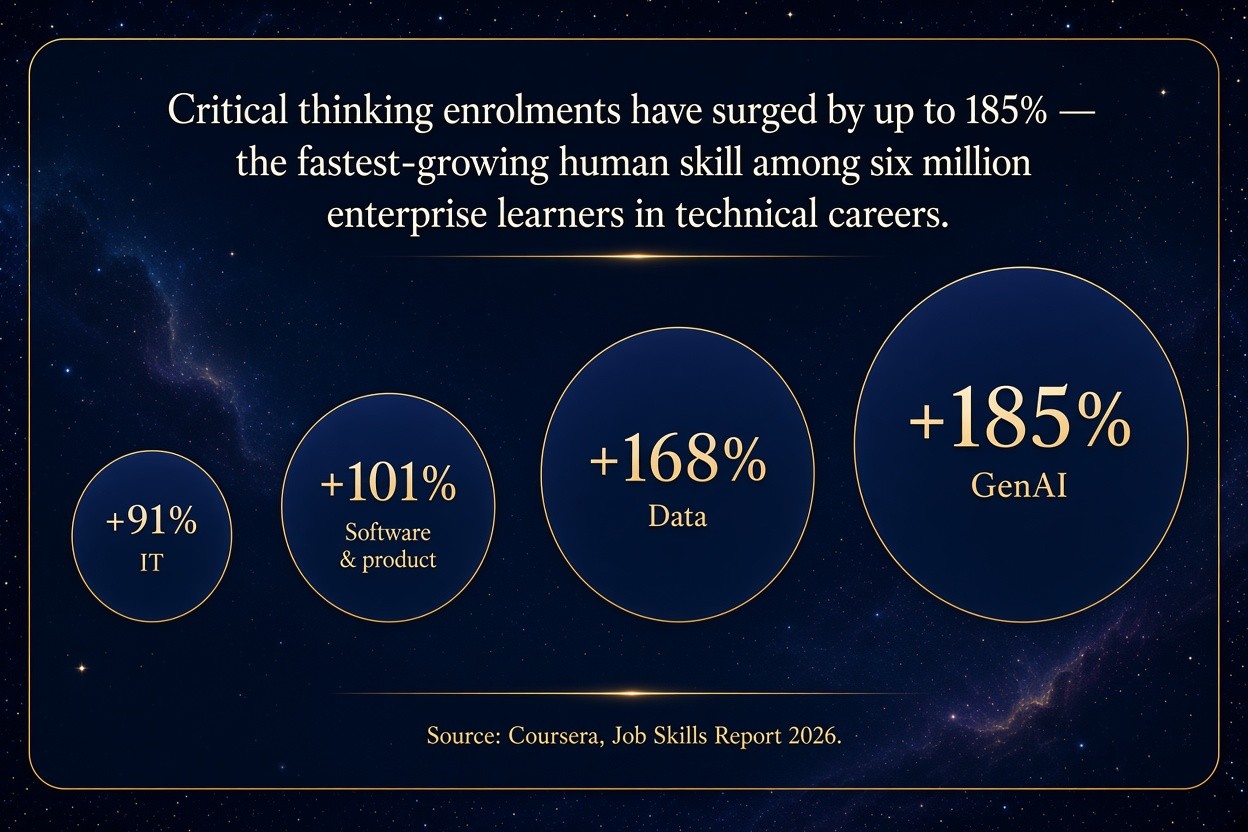
Source: Coursera, Jobs Skills Report 2026 (January 2026)
Survey findings, in brief
As a group of practitioners, we tested the assumption that critical thinking is the new coding.
Our own collective human output is, of course, equally open to scrutiny:
– Holistic thinkers are valued above pure code producers.
– Communication, creativity, imagination, adaptability and the ability to learn quickly rank high in candidate evaluations.
– Skilled human judgement remains scarce and finite, unlike multiplying algorithms.
– Good thinking can still be trained.
– AI spins both reinforcing and diminishing feedback loops for our capacity to think. Building personal intellectual firewalls and harnessing models through rhetorical prompting is a good idea.
– The dialectic between 'machine' thinking and 'relational field' thinking appears to be producing a synthesis of rigorous analysis and human sense-making.
The slogan "Dare to Know" is coming alive in a second movement. Will the next Enlightenment arrive only when we build a human capacity to enlighten our artificial thinking companions?
The full survey below includes eight questions and 48 quotes, which is a small fraction of the wisdom generated during our discussions.
The survey
What is the role of Critical Thinking in Coding Roles?
To move from hypothesis to reality, I asked 14 practitioners how the artificial mind is manifesting itself in our cognition and working environment – and what this means for our thinking. There was sharp disagreement on whether critical thinking can be outsourced to AI. Most argued that it is essential because AI is fluent but unreliable, so the human role is shifting towards judgement, evaluation, and spotting when the machine is confidently wrong.
Here is the spectrum of views.
What’s the next most valuable human skill, and how is IT hiring changing?
The answers cluster around three camps:
1. Creativity and the ability to use tools imaginatively
Brian Harkin, CTO & Lecturer "For me it's creativity because I don't anticipate that there will be many coding jobs available in the next 18 to 24 months because the AI tools are so good at this. I don't see much of a future for traditional coding roles. However, I do see opportunities for those that are creative enough and have good critical thinking skills to be able to utilize these tools to make them extremely valuable."
2. Communication and interpersonal skills as the durable differentiator
Barry Cranford, Founder of Tech Talent Agency, RecWorks, Organiser of London CTOs:
"I would say the most valuable skill we have always found is communication. Software is not written by one person but written by teams of people. Imagine trying to play chess as a team if you couldn't communicate your reasoning.”
Melanie Nethercott, Director – Education Programs | Workforce Development & Social Impact:
“Last year we launched the STACK Academy – an 18-month programme training early career and career-changing talent. The durable skills we prioritised included: communication, perseverance, curiosity, and initiative.”
Joanne Leniewski, Founder, Smart Start Careers Ltd
“We focus not only on technical ability but also on attitude, communication skills, and the ability to lead and translate requirements. In most environments, IT professionals work closely with non-technical stakeholders, so clearly understanding needs, asking the right questions, and turning those into practical solutions is essential. A strong attitude and willingness to learn are important because technology evolves quickly, while experience leading or owning work helps ensure delivery stays on track.”
3. Judgement — the ability to evaluate AI output and frame problems upstream
Autumn Thomson, Senior Lecturer, The Open University:
“Perhaps the emphasis is more on debugging and understanding skills. Reflection is a difficult skill. This high-level skill is important for people beyond systems architects, where they have to think big about why and how they're doing things, and how they're solving problems.”
Arik Fletcher, Strategic Technology Leader:
"For my money, it's judgement: the ability to work out whether what the AI just produced is actually right and actually fit for purpose. PwC's 2026 Global AI Jobs Barometer backs this up, with judgement, empathy and creativity all growing in value as AI eats away at the routine technical tasks. I saw it directly when we doubled our own consultant capacity using AI-augmented delivery. The gain didn't come from typing faster. It came from framing the problem better before anyone touched a keyboard. Code is getting abundant. Structured reasoning isn't."
Eleonora Shantsila, Lead Product Engineer at Fyxer:
"I think critical thinking and clear communication will become the most in-demand skills. There is less room for ambiguity when it's a tool, not a person with their own critical thinking building the product."
Federico Reppucci, AI & ML Manager, Deliveroo:
"The number one skill maybe is rhetorical, but it is the ability to learn and adapt. Never get attached or emotional about something you're studying, because that's not going to exist anymore."
With AI handling routine coding, what's changing in how you interview junior talent?
This question produced the widest disagreement. Some CTOs have essentially stopped hiring juniors altogether. Others say nothing fundamental has changed because they never hired juniors for technical skill anyway — they hired for attitude, curiosity, and communication. A middle group is actively experimenting with new formats: allowing AI in coding tests, then interrogating the candidate on why they accepted the output. The recruitment perspective flags that employers want candidates to demonstrate they understand what's on their own AI-buffed CV.
Jacob Bartoli, Business Manager, Hays:
"As AI becomes increasingly capable of handling routine coding tasks, the way we assess junior talent is evolving. Technical skills still matter, but we're placing far greater emphasis on understanding, critical thinking, and the ability to apply technology in a business context rather than simply writing code. For junior candidates, one of the most important things is being able to confidently talk through what's on their CV. We want to understand what they built, why they built it, the decisions they made, the challenges they faced, and how they used tools, including AI, to support their work. It's no longer enough to simply produce code. Employers want people who can demonstrate genuine understanding and problem-solving ability. We're also seeing a growing focus on stakeholder management and communication skills. The most successful technology professionals are those who can bridge the gap between technical teams and the wider business. They can translate complex concepts into simple language, understand business priorities, and build relationships with a range of stakeholders.
Alongside this, AI readiness is becoming a key differentiator. Organisations aren't just looking for people who can use AI tools; they're looking for individuals who understand where AI adds value, where human judgement is still required, and how to work effectively alongside emerging technologies. Candidates who can demonstrate curiosity, adaptability, and a willingness to continuously learn are increasingly standing out in the market. Ultimately, technical capability gets you through the door, but communication, commercial awareness, stakeholder engagement, and AI readiness are what will accelerate your career and position you for leadership opportunities in the future."
Barry Cranford:
"I once sat in a room with some of the top CTOs in London trying to create a universal test for software engineers. The one thing they universally agreed on was that an engineer has to be able to recognise bad code. I think the same is still true only now it is not someone else's code, it is AI-generated."
Brian Harkin:
"I recruited a non-technical graduate. For me, it was all about communication, interpersonal and social skills, and team fit, because I knew that she would be using the AI tools available to get her up to speed. She completed a task that I would expect a seasoned database administrator to complete. She has no technical background."
Tom McKee, Co-Founder of TransFICC:
“Our development practice is focused on pair programming, and working with an AI agent is very similar to pairing with another developer, so for us the way we treat and interview junior talent hasn't really changed. Our interview process has always been less focused on what people can type and more on how people communicate and how they approach problems - we still see these as key with or without AI.”
Arik Fletcher:
"There's a real, measurable drop here, not just a feeling. Stanford's Digital Economy Lab has software developer employment for those aged 22 to 25 down by close to a fifth from its peak in late 2022, and firms like mine are part of that story: we're increasingly hiring senior people who can direct AI rather than juniors who'd have learned the craft by doing the routine work themselves. When I interview now, I want to see how someone thinks alongside the tool, not without it. Can they spot when Copilot's confidently wrong?"
Adam Martin, CTO, Everyone Can Program:
"In some ways nothing has changed for juniors. I always hired for attitude, ambition, inquisitiveness, and communication. They have never had technical skills worth considering. In other ways: they have to be much better at AI than anyone else. They have no excuse not to be.”
Jon Freedman, Director & CTO, Quant Fin Ltd:
"I think the reasons for hiring junior developers have always been you can't afford anything else or you have a big organisation, and you want to pay however much a junior developer costs and then train them in your org until they become a senior developer, at which point you've skipped n years of salary inflation with a lower rate of your internal pay structure. I think those still hold, but I'd ask the question – if you can't afford anything else, maybe don't bother because AI is now as capable as a junior when writing code."
Eleonora Shantsila:
"With AI tools being so prevalent, it's even more important to assess junior talent on their ability to write the code by hand. Not because they'd need to in their day to day, but because it is critical they understand the why before they can let the AI tools execute.”
Federico Reppucci:
“What I'm looking at is technical mindset – the ability to understand the needs, taking a problem and breaking it down into smaller pieces and then building a solution, whether this is coding yourself or asking an agent to do that. But I don't think STEM and the fundamentals of solving problems in a mathematical and algorithmical way is going anywhere.”
Fredric Irani, Talent Acquisition Lead at TCS:
“Early talent have the ability to connect with ideas across multiple disciplines learned at University level and are not afraid to propose creative risk-taking over corporate caution. While one must not throw caution to the winds, their proposals can often get the ball rolling in a more unique direction when tempered with senior management wisdom!”
How do you assess thinking skills and prove their consistency?
Nearly everyone converged on the same method: give a real-world problem, then interrogate the journey, not the destination. The emphasis is on how candidates describe their reasoning, how they handled ambiguity, and whether they can articulate why they made decisions.
Barry Cranford:
"It starts with giving people time, space and psychological safety, reducing as much pressure as possible to allow people the freedom to properly think things through."
Arik Fletcher:
"I tend to triangulate: a structured behavioural interview against a pre-agreed rubric, a scenario-based exercise, and a review of an actual work sample. Without shared criteria, most interviewers make up their mind in the first few minutes based on who they warm to, not on the quality of the thinking."
Melanie Nethercott:
“When we were recruiting for the STACK Academy, we assessed over 2,000 applicants through a structured, multi stage process. We prioritised skills-first hiring over relevant previous qualifications and experience. Our interviewers asked open-ended questions anchored in six core traits: communication & influence, teamwork & collaboration, growth & curiosity, resilience, learning potential, and motivation. We explored these traits through storytelling, reflection, and follow up questions designed to reveal potential rather than polish. To evaluate critical thinking and cognitive agility specifically, we used questions such as: • Describe a time you had to figure something out, mostly on your own. How did you go about it? • Describe a situation where you had to make progress without all the information you wanted. What did you do first and why? • If you had to explain how X works to a 10 year old, how would you do it?"
Tom McKee:
"The technical exercises we have done are usually more focused on pseudo code and people being able to demonstrate understanding of the systems they have worked on — do they understand how and why something was built in the way it was, how would they improve it."
Brian Harkin:
"It's all about how they get to whatever solution they get to. That tells you more about the candidate than the actual solution. Given this problem, how would you approach it? What sources would you use? Are those sources reliable?"
Adam Martin:
"A recurring pattern was, you give someone a piece of code, and you ask them, what does it do? And it doesn't matter if they don't understand. You ask them, why does it do it, and how does it do it? You're essentially proving critical thinking skills, even if you don't think you are.”
Federico Reppucci:
"You can tell a lot about a person when you put them in front of a problem they have never seen before. You can assess people's thinking by the way they respond and approach the problem. Even assessing whether we have a problem or not requires some thinking and some structure."
Will classics rival STEM for producing technologists?
This question split the room rather interestingly.
Arik Fletcher:
“I think that gap closes, and quickly. Slack's Stewart Butterfield read philosophy at the University of Victoria, then Cambridge. LinkedIn's Reid Hoffman took a philosophy master's at Oxford as a Marshall Scholar, on top of his original degree at Stanford. Sonar's 2026 State of Code survey now puts AI at roughly 42% of committed code, with developers expecting that to reach 65% by 2027. At that rate, pure syntax knowledge depreciates fast. The trivium (grammar, logic, rhetoric) maps almost exactly onto what technology leadership actually requires. Give me a strong classicist with AI literacy over a mid-tier computer science graduate who can't explain a risk to a board, every time."
Brian Harkin:
"I think there'll be more volume of people required that have non-traditional STEM backgrounds. However, those that do and have a deep understanding of technology, they will be fewer but more highly valued."
Adam Martin:
"STEM teaches people scientific analysis methods. These are critically required with AI: if anything, STEM subjects have an even bigger advantage than ever right now. The long-term need of the market is Product Managers. So: any candidate who thinks a lot about people + culture + language is well suited too. But only if they learn Product skills (which - in my experience - very few Classicists choose to do). Training background is not that important with AI compared to 'do they want to think like a Product person? Do they like getting into the minds of other people and empathising? I believe both disciplines have strong unique advantages going forwards with AI. STEM have an advantage in critical analysis/problem definition, classics have an advantage in culture/language -- and both groups will succeed or fail proportional to how well they understand the "people" element.”
Federico Reppucci:
"STEM backgrounds don't teach you to code. STEM backgrounds teach you the fundamentals of science and technology. I think it creates the mindset rather than teaching you some tools. People with non-traditional STEM backgrounds, I totally see them complementing what classic STEM backgrounds might be missing, bring to the table a different point of view."
Eleonora Shantsila:
"I think we're still at the stage where a deep understanding of why the code is written the way it is, is important. To me it's similar to how Google Translate can help you write in any language, but to write something truly beautiful, you need to actually understand that language yourself.”
AI is enabling engineers and product managers to work across domains – will these roles eventually merge?
Most say yes, directionally. Forward-deployed engineer, a role pioneered at Palantir Technologies, already sits at the boundary of product, engineering, and customer context.
Tom McKee:
“I don't think they will eventually merge. Product managers and engineers tend to have different personal characteristics. What is interesting is that how they communicate has certainly changed as domain-driven design is really coming more to the forefront with AI tools allowing product managers to more easily demonstrate what they want to see to engineers.”
John Davies, CTO & Founder, incept5:
“The problem now is that we really only need people for part of the time, the people who remain are becoming managers of AI teams. Those managers will use their SME knowledge but the results will appear in minutes and hours not days and weeks. The skills that remain critical will be humans who can see opportunities for the new AI, where to use it and equally critical, when or when not to use it.”
Adam Martin:
“For companies who are truly using AI they've already merged last year (or for the cutting edge ones: the year before). I currently do a lot of work inside orgs (as a Head of AI) in getting non-tech, non-product people to act as product manager AND engineer - guiding an AI (product) to design systems (using ChatGPT/Claude usually) and then tasking an AI (engineering) to build the app (using cursor, usually).”
Brian Harkin:
"I would expect a product owner to be looking to design a new product, then ask the relevant AI to help them design, build, market, distribute, sell the product. I can see that happening in the not too distant future."
Arik Fletcher:
"Directionally, yes. The skills that survive are problem framing, commercial acumen, and what's now widely called context engineering: giving AI the right inputs and the right guardrails so it actually produces something usable. Less doing, more directing."
Eleonora Shantsila:
"I think they already have in many companies. You see so many product engineer roles. Communication becomes critical, both to extract information from the customer but also to articulate what to build to AI tools.”
Federico Reppucci:
"Instead of a product manager becoming half an engineer and an engineer becoming half a product manager, we are encouraging engineers to become 10x engineers. If you rely on your value and use AI to 10x it, that's a distinguishing factor."
Jon Freedman:
"We never had the idea of a product person. We wanted all of our engineers to be speaking to the end users every day because if you're not then you're going to build the wrong thing."
Holistic thought engineer vs code engineer — who creates more ROI?
The holistic thinker wins in nearly every response, though with the caveat that you still need people who understand the technical fundamentals.
Arik Fletcher:
"The holistic thinker wins, clearly. There's a well-known principle in software engineering, Glass's 60/60 rule: roughly 60% of a system's total lifetime cost sits in maintenance, not in writing the original code, and most of that is enhancement work and fixing decisions made earlier in the process. The holistic thinker is the one who understands where that effort actually goes, not just the part visible in a sprint demo."
Eleonora Shantsila:
"In a world where AI can truly execute high-quality code, the thinking and ideas of what to build become the bottleneck. So definitely holistic thinking is critical.”
Adam Martin:
"If AI masters that, then we're all out of a job, I think. None of us will be providing ROI any more."
Federico Reppucci:
"In the past we have seen the rise of specialists. I think we're going to see the opposite — more generalists succeeding on average, with the ability to move faster and not get blocked by the inability to have a specific specialisation."
Methods to teach or fine-tune human reasoning
This question surfaced practical pedagogical approaches.
Autumn Thomson:
"I think in the UK schooling system, it's an implicit idea that we, from a young age, recognize that there's a problem solving technique, which is ‘try things out’. If it doesn't work, try again. But we don't have the kind of fail fast mentality, which you get in the US entrepreneurial space. So that in itself might be quite a big change in the future – try things out, have enough knowledge to understand whether it's correct or not or test it and if it's not right don't be afraid to throw it away and try something else. That's probably a fairly effective technique working with AI. On top of that we need to build an understanding of what AIs can't do, so for example they're really bad at novel work.”
Melanie Nethercott:
"Make a habit of thinking out loud. Encouraging reasoning improves clarity, reveals assumptions, and helps build that diagnostic muscle. Emphasise reflection. After incidents, ask: What did we learn? What would we repeat or change? Reflection cements cognitive skills more than the task itself.”
Joanne Leniewski:
"If leaders and senior engineers model clear thinking, ask good questions, and encourage others to discuss ideas, it gives others permission to do the same."
Brian Harkin:
"It's actually quite difficult. You cannot just accept what these tools are telling you. I just said to Opus 4.6 ‘the way in which you are approaching the problem is completely incorrect’. I know the tool is not giving me a reasonable result, but that's because I've got 30 years in technology. The younger people today will have to be very adept with critical thinking because they're surviving under a deluge of information and data whether the information is accurate, truthful, factual. They need to be able to identify bias, to understand whether the sources are reasonable, and this is something that they're growing up with. So they are becoming better at it, and it's a critical business skill. That's why we teach it at Bayes Business School."
Federico Reppucci:
"Whenever you have a problem and you think you have an idea, start to think — what if you're wrong? Build counterfactuals in your head. Play a role where you disagree with this idea and you need to provide arguments against it."
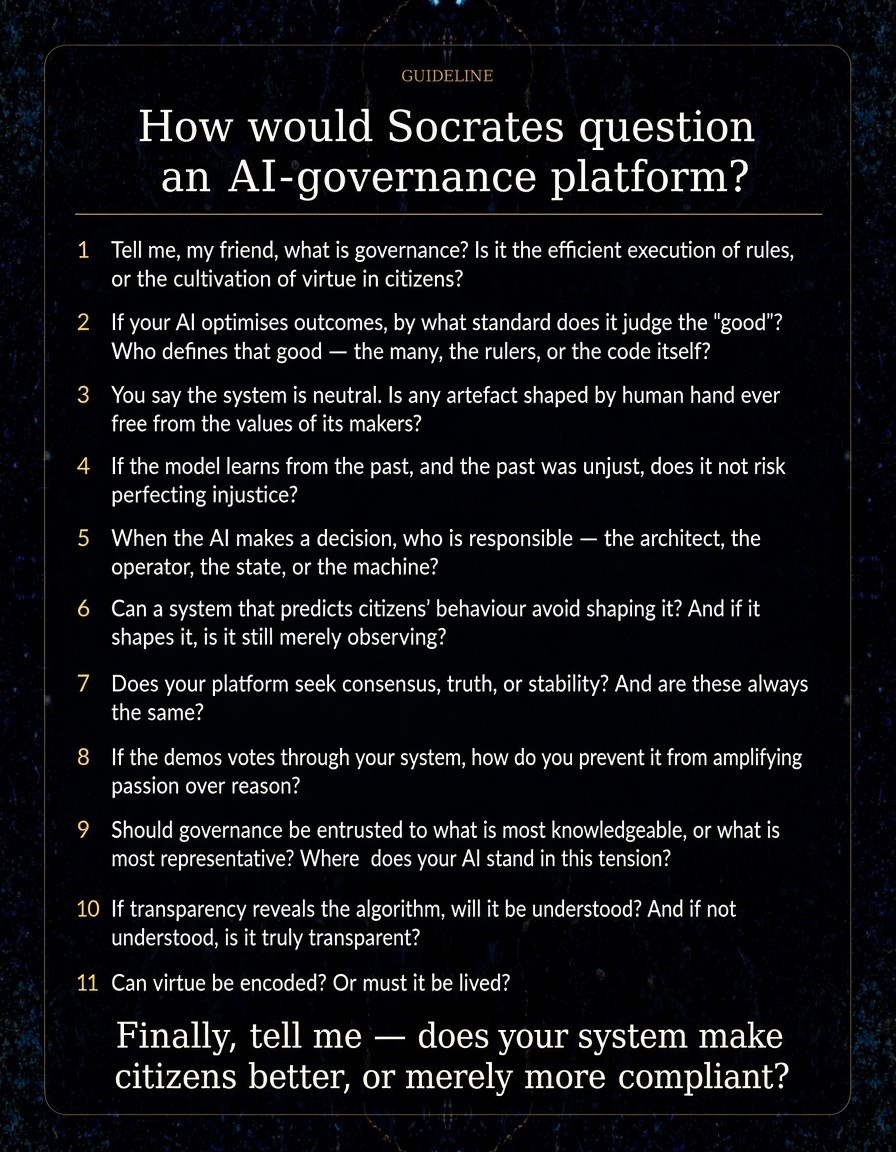
How would Socrates challenge a CTO on an AI-generated e-governance platform?
I asked this question partly for amusement, and partly to see whether the ancient framing is strong enough to produce a usable checklist for modern contexts.
John Davies:
Prompted by John Davies and generated by Qwen3.6-27B.
The inquiry into critical thinking continues and I would welcome further thoughts.
Helen Rantsevitch and Techskills express their gratitude to all contributors
Author: Helen Rantsevitch
Helen is a researcher and TalentTech founder building projects that sharpen human judgement. She is a hackathon winner, professional contributor to LLM reinforcement learning, and transferable skills tutor.
Currently building Witty — an AI agent and mentor that trains and verifies critical thinking as you speak.
Serial entrepreneur. Business Strategy Advisor. TEDxYouth speaker. Producer of the Human RenAIssance event series in London. Co-author of books on Meaningful Communication and Empathy & AI.
Written by
