

Jenny Taylor MBE: Championing Apprenticeships and Shaping the Future of Tech Talent
Jenny Taylor MBE: Championing Apprenticeships and Shaping the Future of Tech Talent
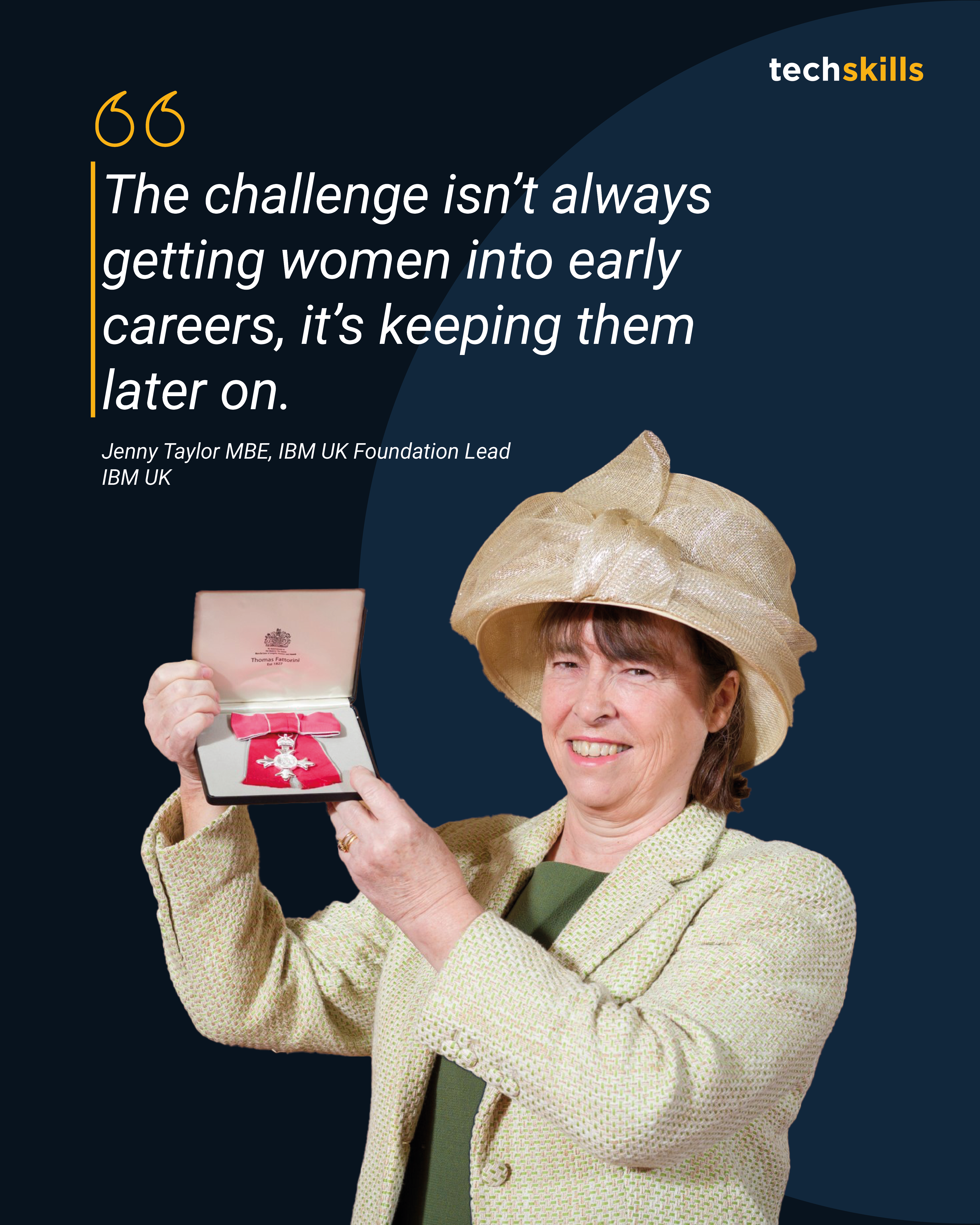
For Jenny Taylor MBE, a career in technology has never been defined by a rigid plan. Instead, it has been shaped by curiosity, resilience and a deep commitment to developing the next generation of talent.
After more than 40 years at IBM, Jenny has helped shape one of the UK’s most influential early careers ecosystems. As Leader of IBM UK’s Early Professional Programmes, she oversees graduate, apprentice, intern and T Level pathways across the organisation, supporting thousands of young professionals entering the technology sector.
Yet Jenny’s journey into leadership and into the national conversation around digital skills was anything but predictable.
“I didn’t have a plan. Definitely no plan,”she reflects. “I just found my way, and eventually found the job I loved.”
From hardware to the AI era
When Jenny first joined IBM, the technology landscape looked very different.
“When I joined IBM, there was no services business as we know it today. It was essentially a hardware company with some software.”
Over the decades she has watched the sector transform from hardware and infrastructure to services, cloud computing and now artificial intelligence.
Despite the rapid pace of innovation, Jenny views the current conversation around AI with the perspective that comes from decades in the industry.
“AI isn’t taking people’s jobs. It’s creating different ones,” she says.
“Every new technology does that. Something else will come along in five or ten years and we’ll adapt to that too.”
A passion for early careers
Jenny describes her time at IBM asthree careers within one organisation, beginning in distribution, moving into client-facing project management, and eventually discovering her passion in early careers development.
The turning point came unexpectedly.
Whilst working in project management, she happened to sit alongside a group of new graduates.
“You naturally start chatting to them and hearing what they’re doing,” she recalls.
“I realised I enjoyed giving advice and guidance.”
When the opportunity arose to manage the graduate programme, she applied and quickly knew it was the right move.
“By the time the manager and I had gone to the coffee machine and come back again, I knew it was for me.”
What began as a graduate programme has since evolved into a comprehensive early careers ecosystem, incorporating apprenticeships, internships and T Level placements.
Today, Jenny leads IBM’s UK’s Early Professional programmes, which have supported hundreds of early professionals entering the technology sector.
“They tell us we make a difference to them,” she says. “And that’s incredibly rewarding.”
The ITMB programme and the start of employer-led digital education
Jenny’s involvement in shaping the UK’s digital skills landscape began through her work with theITMB (Information Technology Management for Business) degree, developed through techskills and employer partners.
At the time, the programme represented a new approach to digital education:employer-led curriculum design, where industry worked directly with universities to shape what learners studied and how they developed workplace skills.
But the programme also had another important ambition,broadening participation in technology careers, particularly among women.
“One of the reasons we introduced the ITMB degree from the start was to attract more women into technology,” Jenny explains.
Traditional computing courses had long struggled with gender imbalance, but ITMB was designed differently, combining technical understanding with business, communication and real-world industry experience.
The approach proved promising. According to Jenny, participation by women on ITMB programmes has historically been significantly higher than typical computing courses.
“The last statistics I saw were around 33% female participation which is definitely higher than the wider industry.”
For Jenny, ITMB demonstrated what becomes possible when employers and educators work together to rethink how tech education is designed and delivered.
The programme also proved transformative for her personally.
It was through techskills and the ITMB employer network that Jenny first began representing IBM externally.
Speaking on behalf of IBM in industry forums initially felt daunting. She remembers worrying about committing the company to something she couldn’t deliver.
*“That was the first time I represented IBM outside the company, and I was terrified”,*she laughs.
But over time, as ITMB grew and partnerships strengthened between employers and universities, Jenny’s confidence grew too.
“Then I got comfortable in it… and people started looking at me as an expert.”
Looking back, she sees that moment as pivotal.
“techskills plays a really big part in my journey,” she reflects.
Building and protecting the digital degree apprenticeship
When the UK government asked industry to develop theDigital and Technology Solutions degree apprenticeship, Jenny was already deeply embedded in employer education collaboration through the ITMB.
That experience allowed employers and universities to move quickly.
“We were asked to develop the first-degree apprenticeship because we already had the ITMB degree,” she explains.
“We already had an employer-led curriculum and the relationships between universities and employers.”
But the programme soon faced a serious threat.
At one stage, policy discussions proposed removing the degree element entirely, leaving a standalone Level 6 apprenticeship qualification instead.
“There was a real threat,” Jenny recalls. “The government wanted the degree apprenticeship to be a standalone Level 6 and not a degree.”
For employers and apprentices alike, that would have undermined the value of the programme.
“All the apprentices said, ‘We wouldn’t have done it without the degree.’ And all the employers said, ‘What are you doing?’”
Jenny helped coordinate a coordinated industry response, bringing together employers and professional bodies to build a compelling case.
“I wrote individually to every single employer and to all the professional bodies. I think we had seven professional bodies endorsing the need for the degree.”
It took persistence.
“It took a couple of years actually.”
But eventually, the campaign succeeded and the policy was changed.
“They actually changed the policy. Everyone said they wouldn’t. But they did.”
Today, degree apprenticeships are widely recognised as one of the most effective pathways into digital careers.
Jenny still keeps the business case that helped protect them.
“I’ve still got it,” she laughs. “I’m very proud of it.”
Apprenticeships as a career catalyst
Jenny has long argued that apprenticeships offer one of the strongest foundations for a career in technology.
“They combine the knowledge, skills and behaviours you need in the workplace,”she explains. “It’s the perfect combination.”
For employers, apprentices graduate with both academic qualifications and several years of industry experience. For learners, the pathway offers opportunity, mobility and confidence.
Jenny’s own career reflects the power of unexpected opportunities.
“If I can do it, anybody can,” she says*. “I joined IBM in a junior role and look what happened.”*
Her advocacy for apprenticeships has earned national recognition, including Apprenticeship Champion of the Year and anMBE for Services to Education in 2022.
The honour, she explains, represented years of championing the apprenticeship model.
“It wasn’t for my job at IBM. It was for championing apprenticeships as a concept.”
Women in Tech: The progress and the persistent challenges
Whilst Jenny says she personally did not experience direct barriers during her career at IBM, she recognises that the broader tech sector still faces gender imbalance.
“The challenge isn’t necessarily getting women into early career programmes,” she explains. “It’s later on, when people start families and the balance becomes harder.”
Another issue remains the pipeline of women entering technical roles.
“The more technical roles still tend to attract more men,” she says. “Encouraging young women in schools and universities to see tech as a career is still a challenge.”
In Jenny’s view, the roots of the issue start long before the workplace.
“You look at toys in shops, what’s aimed at boys and what’s aimed at girls and the messaging starts incredibly early.”
Despite decades of outreach programmes across the sector, the overall proportion of women working in technology has remained stubbornly low.
“We’ve been talking about this for years,” she says.
“And the overall numbers haven’t shifted as much as we hoped.”
However, employer-led initiatives such as Tech Industry Gold degrees have shown stronger representation than traditional computing pathways.Confidence, leadership and knowing yourself
One of Jenny’s most candid reflections is how long it took her to build confidence as a leader.
“Success came relatively late for me,” she says. “I had no expectation of having a career in business.”
Growing up in a generation where women were often expected to leave work after marriage, career ambition simply wasn’t part of the cultural narrative.
“If you got married, you were expected to stop working,” she says. “That’s how it was.”
Her confidence grew gradually, through experience, mentorship and opportunities to represent IBM externally.
Today, Jenny spends around half her time working with government departments, professional bodies and industry organisations shaping national skills policy.
Yet she still describes herself as an introvert.
“Introverts like to think before they speak,” she says. “When they do speak, they want it to be meaningful.”
Understanding her own working style has been key to navigating leadership.
A legacy measured in people
When asked about her legacy, Jenny doesn’t point to policy changes or awards.
Instead, she talks about the people whose careers began through the programmes she helped build.
“When I posted about my 40 years at IBM, so many messages came from people I managed years ago as graduates.”
For Jenny, those messages matter more than any title.
“If you’ve helped make people’s lives better, that’s what matters.”
After four decades shaping early careers and digital skills programmes, she believes the impact is clear.
“We say we change lives through these programmes,” she says. “And I honestly believe we do.”