

“You get everything back”: James Stephenson on apprenticeships, opportunity and building a digital career
“You get everything back”: James Stephenson on apprenticeships, opportunity and building a digital career
Automation, enterprise transformation, industry advocacy and a first-class degree, James Stephenson shares how employer-aligned learning helped shape his digital career through a Tech Industry Gold accredited apprenticeship

For James Stephenson, a career in technology was never just about learning technical concepts. It was about solving problems, improving systems and understanding how technology can create meaningful impact in the real world.
That mindset led him towards the Tech Industry Gold accredited Digital and Technology Solutions Professional (DTSP) degree apprenticeship with BT, delivered through University of Staffordshire.
Since starting the programme, James has contributed to large-scale automation and transformation initiatives, progressed into a Junior Enterprise Architect role and completed his apprenticeship with a first-class degree, demonstrating the impact of employer-aligned digital education in practice.
For James, technology first became interesting because it solved real problems.
Growing up in a family of teachers, he remembers seeing boxes of exam papers filling the house during marking periods and wondering why the process felt so inefficient.
“There were piles and piles of boxes throughout the house every summer,” James recalls. “Even as a kid, I remember thinking surely there has to be a faster and better way of doing this.”
That curiosity around systems, efficiency and improvement stayed with him. Years later, after spending time with the IT technician at his school and seeing the networking infrastructure behind the scenes, technology began to feel less like a classroom subject and more like something tangible and exciting.
“He showed me how the school network worked and what went into maintaining it,” James explains. “That was the first time I really saw technology as something practical that solved real problems.”
It was also the first time James became aware of apprenticeships as a route into digital careers. The technician himself was completing an apprenticeship whilst working at the school, something James says changed his perspective on what learning and career development could look like.
“One of the things that stood out to me was that he was learning whilst doing the job and getting paid at the same time,” James says. “That felt much more practical and engaging than anything else I’d seen at that point.”
Discovering a practical route into digital careers
Although apprenticeships were briefly mentioned during school and college, James says there was limited awareness and support around digital apprenticeship opportunities and the application process itself.
Instead, much of the journey was self-driven.
James was drawn to a learning model that combined technical education with real responsibility. Rather than separating study from industry, the degree apprenticeship offered the opportunity to build professional experience, technical capability and business understanding simultaneously.
*“I learned very quickly that I work best practically,”*he explains. “I wanted to be out there doing things, solving problems and working with technology in real environments.”
That decision would ultimately shape the direction of his career.
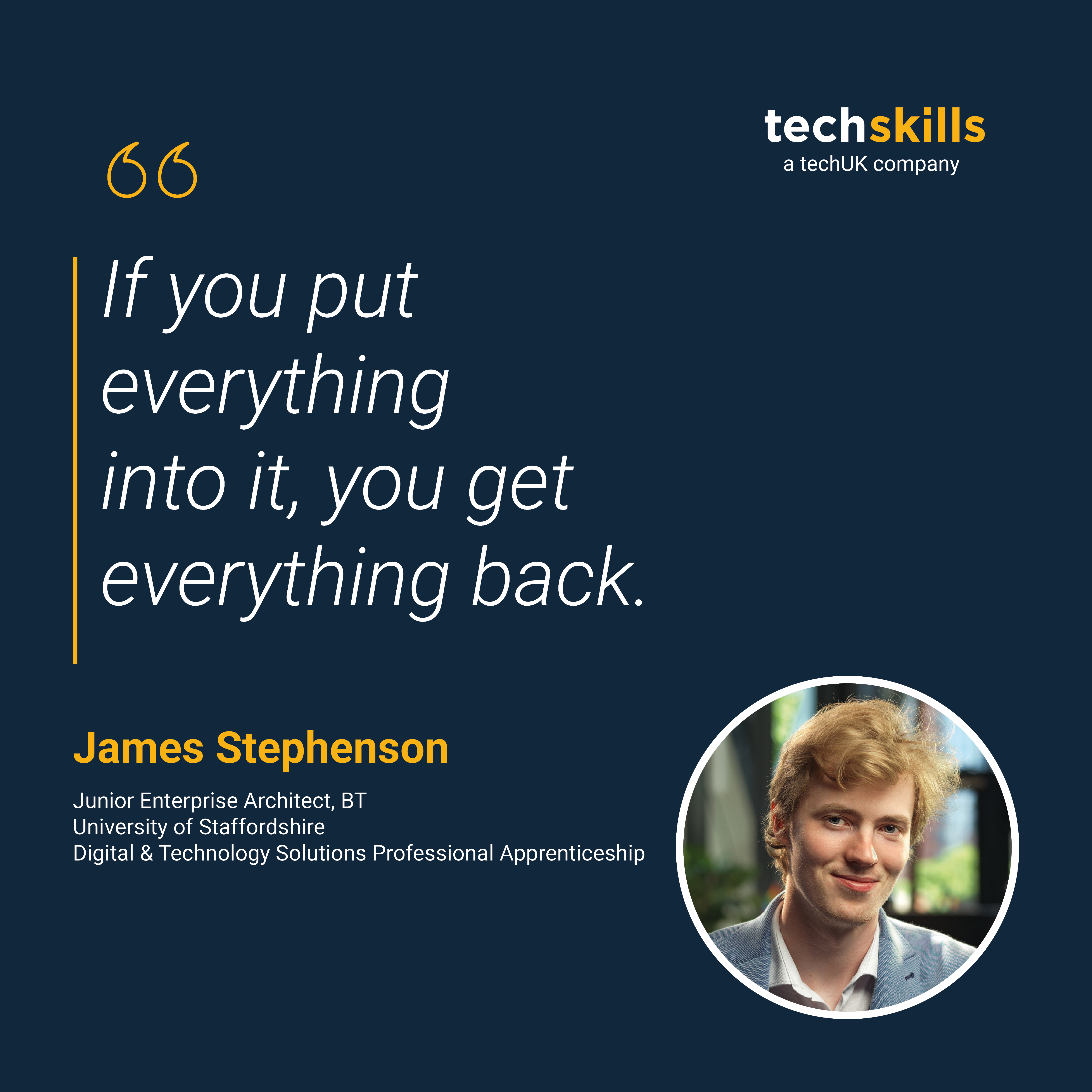
“I was told this would be the hardest thing I’d ever done,” James says. “But if you put everything into it, you get everything back. That has been fundamentally true.”
Taking on real responsibility early
Throughout the apprenticeship, James gained exposure to complex technical environments across major banking, financial sector and public sector customers.
His responsibilities evolved rapidly. What began as shadowing experienced colleagues soon developed into designing technical solutions, supporting infrastructure activity and contributing to automation and transformation initiatives across enterprise-scale environments.
Today, James works as a Junior Enterprise Architect at BT, supporting digitisation and transformation activity across one of the organisation’s largest commercial customer environments.
One project he is particularly proud of involved reviewing the manual steps required within a network design process.
“There were 36 different manual touchpoints a designer had to search through, filter and deal with in order to produce a design,” James explains. “One of the things I’ve been building is a platform that brings all of that data together and reduces the process down to about five minutes.”
For James, that direct business impact is one of the most valuable parts of apprenticeship learning.
The apprenticeship accelerated his exposure to enterprise-scale environments far earlier than he expected, giving him opportunities to contribute to live transformation activity, complex customer environments and strategic technical projects whilst still studying.
“The progression was very sharp,” James reflects. “I mostly remember surviving the first year. But looking back now, it gave me exposure and opportunities I could never have imagined at that stage in my career.”
Within a relatively short space of time, James had progressed from learning the foundations of network architecture to supporting automation, transformation and strategic technical initiatives at scale.
Learning shaped by real industry practice
James believes one of the defining strengths of the programme was the close alignment between workplace practice and academic learning.
He credits University of Staffordshire with helping bridge the gap between technical capability and professional confidence, creating a learning environment that felt directly connected to industry reality.
Rather than operating separately, the university and workplace elements reinforced each other. Assessments allowed apprentices to reflect on real technical challenges, whilst workplace experience gave greater depth and relevance to academic learning.
“It is a conversion of information that works so much better when the university and employer work together,” James says. “You get a much better cohesion of information, the apprentices get a better experience, and employers get a better employee.”
That connection between industry and education sits at the heart of Tech Industry Gold accreditation, helping ensure digital and technology programmes remain aligned to employer needs, professional capability and evolving industry expectations.
For James, industry alignment matters because learners, employers and universities all need confidence that programmes are genuinely preparing people for modern digital careers.
“Accreditations are becoming the new normal,” he says. “Students want to know that the course they choose gives them a real chance of getting into employment.”
For the University of Staffordshire, Tech Industry Gold accreditation also helps programmes remain aligned to employer expectations, emerging technologies and the wider digital skills landscape.
Robin Oldham, Course Director - Computer Science: Digital Apprenticeships, MoD and Flexible Learning, explains that the accreditation strengthens opportunities for employer engagement, industry insight and collaboration across the wider Tech Industry Gold community.
“A Tech Industry Gold accredited programme is about far more than planned learning and academic achievement,” Robin explains.
“It encourages learners to engage with wider industry activity, professional practice and opportunities beyond the curriculum itself.”
Robin points to James as someone who fully embraced those opportunities throughout the programme, contributing across course committees, Ofsted inspections, Office for Students visits and conference presentations.
“He is someone we regularly call on for support, and he consistently delivers.”
Alongside the learner experience, he also highlights the value accreditation brings to providers navigating an evolving digital and apprenticeship landscape.
“From a digital apprenticeship perspective, the Tech Industry Gold community of providers and employers has been particularly valuable,” Robin explains.
“It has helped us share and develop practice in response to a constantly changing policy landscape, ensuring our apprenticeships remain relevant and effective.”
Whilst the university already works closely with employers across local, regional and national levels, he explains that Tech Industry Gold further strengthens visibility into wider industry trends and emerging areas of demand.
“It allows us to stay connected to the needs of organisations beyond those we work with directly,” Robin explains.
“That helps expose learners to areas of the technology sector they might not otherwise encounter, whilst also giving employers additional confidence that programmes remain aligned with industry expectations.”
James also believes employer involvement plays a critical role in ensuring programmes evolve alongside industry itself.
“No employer is going to sign onto a course unless they genuinely believe it reflects what industry needs.”
Developing confidence beyond technical capability
Whilst the technical knowledge developed throughout the programme was significant, James says some of the biggest areas of growth came through communication, critical thinking and professional confidence.
He credits University of Staffordshire with helping him articulate ideas more clearly, structure his thinking and explain complex technical concepts in ways that make sense within professional business environments.
“The university helped me process my own thoughts better, structure them, evaluate options and present them,” he explains.
Reflecting on James’ progression throughout the apprenticeship, Robin recalls early conversations around leadership, collaboration and professional growth.
“I remember in the early stages of the apprenticeship challenging James on his role in a group assignment he had completed in college before joining us,” they explain.
“While the final outcome was strong, it became clear that he had taken on most of the work himself because the rest of the group had not contributed as expected. That gave us the opportunity to step back and discuss what effective leadership in the digital space really looks like.”
Rather than focusing purely on individual achievement, the conversation centred around developing team performance, communication and wider professional responsibility.
“I saw that approach develop further throughout his apprenticeship and recognised in how he progressed through his workplace roles to where he is now.”
One module that left a particular impact was Ethical Hacking, not only because of the technical content, but because the assessment focused on communication and explanation rather than simply technical execution.
“How do you explain a really technical concept to someone who has never touched it before?” James says. “That really stayed with me.”
Another defining part of the programme was his dissertation, an ambitious 710-page project exploring the digital transformation of BT’s managed tooling stack.
The scale and complexity of the project required close collaboration between James, the university and industry stakeholders, creating space for him to think holistically about transformation challenges across a large-scale enterprise environment.
“It was stressful, but incredibly enjoyable,” James reflects. “The university gave me the freedom to explore something that genuinely mattered to the business.”
James also highlights the importance of the university relationships and support network throughout the programme.
“You can’t do it without them,” he says. “People matter in every business, and education is exactly the same.”
Alongside academic support, he also values the sense of community the programme created for apprentices working across different regions and customer environments.
“The university provided the foundation for lifelong friendships on this course,” he says. “That student-life element is something apprentices don’t always get, but it really matters.”
Advocating for better awareness and informed choice
Having experienced the impact of employer-aligned learning first-hand, James has become a strong advocate for apprenticeships, skills policy and greater awareness of alternative routes into digital careers.
He believes perceptions of apprenticeships are still shaped by outdated assumptions that no longer reflect the realities of modern digital and technology programmes.
“The way people think about apprenticeships is often still based on an older version of what apprenticeships used to be,” he says. “That is just not the case anymore.”
For James, the goal is not to suggest apprenticeships are the right route for everyone, but to ensure learners have enough information to make informed choices about their future.
“Give people the information to make an informed choice,” he says. “Let’s change the way careers advice works so people can make a real choice about what they want to do.”
He also believes there needs to be greater awareness of the flexibility within apprenticeship pathways, including progression opportunities across levels, disciplines and specialisms.
“Apprenticeships are far more flexible than people realise,” he explains. “You can move sideways, specialise, progress and build experience in different ways throughout your career.”
Developing beyond the apprenticeship
Having now completed his apprenticeship and achieved a first-class degree, James is focused on the opportunities ahead.
The programme has helped him build strong foundations across technical practice, strategic thinking, communication and large-scale digital transformation work. More importantly, it has given him the confidence to contribute meaningfully within one of the UK’s largest technology organisations.
“What excites me most is the opportunity,” James says. “This course and this approach have given me the foundations and stepping stones to where I want to go.”
James’ story reflects the wider impact of employer-led digital education when learners, employers and providers work together with shared purpose.
Through Tech Industry Gold accreditation, techskills works alongside employers and providers such as University of Staffordshire to help ensure digital and technology programmes remain aligned to evolving industry needs, professional practice and real-world employability.
The Tech Industry Gold accredited Digital and Technology Solutions Professional degree apprenticeship at the University of Staffordshire is one example of how employer-informed learning can help learners develop the technical, professional and business skills needed to thrive within modern digital careers.
For learning providers looking to strengthen employer engagement, industry relevance and learner outcomes, Tech Industry Gold accreditation supports programmes designed around the realities of today’s rapidly evolving digital economy.
Find out more
Explore Tech Industry Gold accredited programmes at University of Staffordshire.
Digital & Technology Solutions Professional Degree Apprenticeship