
Claire Agutter on Leadership, SIAM and Women in Tech
Claire Agutter on Leadership, SIAM and Women in Tech
In a technology landscape defined by complexity, rapid change and growing regulatory pressure, leadership is no longer just about technical expertise. It is about clarity, standards and responsibility.
Claire Agutter has built her career at the intersection of all three.
Today, she is the Founder and Director of Scopism,a globally recognised authority in Service Integration and Management (SIAM), author of the first published SIAM manual, leader of a 4,500+ strong international community spanning 120 countries, and a recognised SDI Distinguished Industry Contributor and HDI Top 25 Thought Leader.
Beyond accolades and global reach, Claire’s influence extends into something equally important: shaping how the next generation enters and evolves within the technology profession.
Through her contribution to Tech Industry Gold accreditation panels, her advocacy for meaningful representation in tech, and her long-standing commitment to professional community-building, she is not simply participating in the industry, she is helping to define its direction.
And for women navigating careers in technology, that visibility, paired with credibility, matters.Understanding the problem behind the problem
Claire’s career began in operational and help desk roles, environments often underestimated, but foundational in building real leadership capability.
“Some of the skills you learn when you’re on a help desk are understanding what people are actually trying to achieve. Sometimes the more angry people seem, the more indication that there’s something really important they’re trying to do.”
That ability to separate emotion from objective, to focus on the problem, not the person, became a defining leadership trait.
She also learned to see technology through a business lens:
“It’s quite often levelled at IT departments that they just focus on the technology. They don’t think about what the business is trying to achieve. Seeing that big picture, that comes through really strongly.”
That perspective ultimately led her to found Scopism and specialise in SIAM, a discipline designed to help organisations manage increasingly complex IT ecosystems.
As organisations moved from single-vendor outsourcing models to managing dozens, sometimes hundreds, of suppliers, the need for structured service integration became critical.
“If you’re not managing your contract and supplier relationships, something at some point is going to either break or you’re missing out on an innovation opportunity.”
SIAM thinking in an AI-driven era of compliance risk, data governance and interconnected supplier ecosystems is essential.
Recognition is secondary to impact
Claire’s sustained industry recognition, including SDI Distinguished Industry Contributor and repeated nominations among the Top 50 Women in UK Tech, has never been her objective.
“I’ve always tried to contribute around the job that I’m doing. Very early in my career that was joining industry bodies, attending events and learning. Gradually, I realised I had things I could reflect back.”
From writing books and blogs to speaking at conferences and serving on governance boards, her work has consistently focused on developing the profession.
“I’ve always tried to give people a hand up whenever I can.”
The recognition, she says, is fulfilling but secondary to impact.
Why industry alignment matters
Claire’s involvement in Tech Industry Gold accreditation panels stems from a deep belief in shaping the next generation of professionals.
“It’s about making sure we’ve got the next generation coming into the tech industry and specifically for me, into IT service management.”
On panels, she reviews programme content in advance, analyses assessor reports, and joins cross-sector discussions alongside employers of all sizes.
She looks beyond syllabus detail.
“The IT industry is changing so rapidly. How are organisations accommodating that? But also, how are they equipping learners with the curiosity and critical thinking skills to continually refresh their own knowledge?”
For Claire, industry alignment is not a compliance exercise. It is about ensuring learners leave education prepared for complexity, change and responsibility.
She also values the diversity lens embedded within the Tech Industry Gold accreditation process:
“It’s not just looking at the syllabus. It’s asking how organisations are encouraging people who might not necessarily come into the IT industry to see that it’s a place for them as well.”
That employer voice, pragmatic, forward-looking and grounded in real-world complexity, strengthens the credibility of Tech Industry Gold accreditation and ensures it reflects evolving industry need.
The panel environment itself offers something equally valuable: perspective. Employers gain insight into emerging skills priorities; sector trends and the evolving expectations placed on tech professionals.
“It helps me understand what’s hot in the IT industry, where employers are focused and where learners want to study.”
For Claire, it is not only professionally valuable but also personally fulfilling.
Women in Tech: Progress, reality and responsibility
Despite increased visibility campaigns, Claire is candid about representation.
“The data suggests not much has changed in terms of percentage of women coming into IT.”
In her own area, IT service management, representation is stronger than in some purely technical domains. But imbalance remains visible.
“Last week I was chairing a workshop with 18 attendees and there was one woman in those 18.”
That confidence, however, does not negate structural realities.
She emphasises the importance of representation:
“Being able to see someone and think, they look like me, I could do that, is incredibly important.”
But she also challenges organisations to move beyond superficial diversity initiatives.
Using the example of product design blind spots, such as the recent campaign of Ring using a networked home security systems to find missing dogs, she highlights how homogeneous teams can overlook real-world implications and the unintended safety risks.
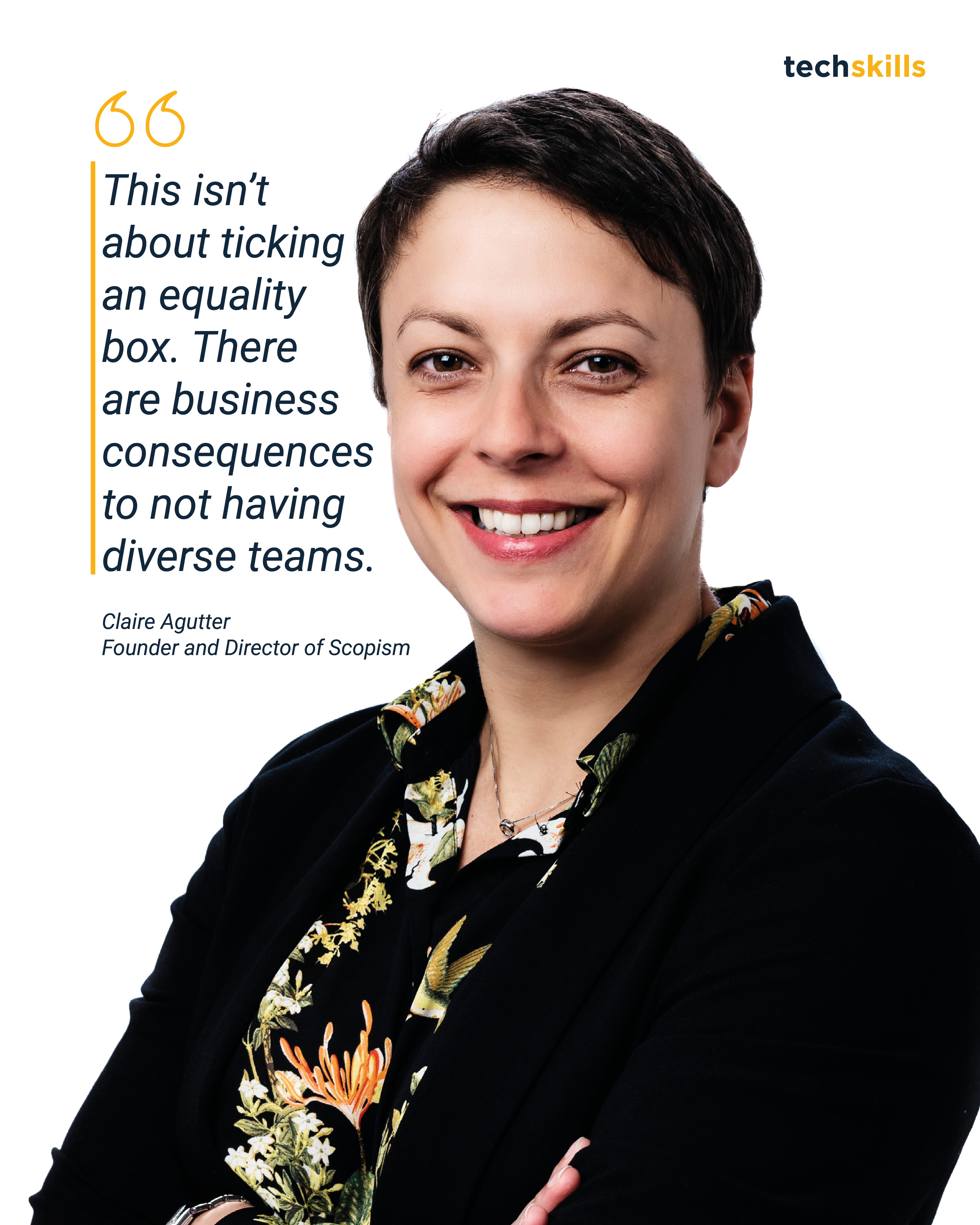
“This isn’t about putting women into teams to tick an equality box. There are business consequences to not having diverse teams.”
Asking the difficult questions
For organisations seeking to improve gender representation, Claire’s advice is direct:
“Take a look at your teams and ask some difficult questions. If they’re not balanced, where is that inequality creeping in?”
Is it recruitment? Is it pipeline? Is it workplace culture?
She also raises a critical point often overlooked in policy discussions: flexibility.
“We know women are majority caregivers. We know they tend to have more responsibilities outside of the office. That’s data. So if flexible working has helped, why are we now trying to force everybody back into the office?”
Without structural support, diversity gains stall.
And as long as inclusion is treated as a compliance exercise rather than a business imperative, progress will remain incremental.
The power of authentic networks
Claire speaks passionately about the power of networks, reframed not as transactional “networking”, but as authentic relationship-building.
“When I look back across my career, I’ve always been networking. I just didn’t understand I was doing it.”
From industry forums to niche communities, she believes these ecosystems accelerate collective learning and provide belonging, particularly for women who may feel underrepresented in traditional corporate structures.
While she questions whether “women in tech” events sometimes risk creating silos, she also acknowledges their impact:
“Some of the network relationships I’ve built with women in tech over the years have been unbelievably supportive.”
Connection, visibility and shared experience still matter.
A moment of opportunity
For those entering tech today, Claire sees immense possibility.
Technology has lowered barriers to entrepreneurship. AI is accelerating innovation. Portfolio careers and flexible models are becoming more viable.
“It’s a privilege to be able to think, I’d like to start a business, and thanks to technology, you can have that up and running by the end of the week.”
For women especially, this flexibility can reshape traditional career constraints.
From representation to influence
Claire Agutter’s contribution to industry is not confined to her own business and cannot be reduced to only titles or awards.
Through shaping SIAM best practice, building global communities, mentoring practitioners, and contributing her expertise to Tech Industry Gold accreditation panels, she is actively influencing how technology is taught, delivered and governed.
Her career illustrates a powerful truth: representation is not simply about being visible.
What moves an industry forward is when women are not only present in the room, but shaping the standards, asking the difficult questions, and influencing what “good” looks like for the next generation.
The industry moves forwards for everyone when women are not just present in tech but defining it.
Claire’s leadership reflects that principle.
As Claire puts it:
“We’re in an age of immense opportunity.”
The question for the industry is whether it will match that opportunity with intention.