

The Future of Digital Talent Starts with Better Questions About Skills, Judgement and AI
The Future of Digital Talent Starts with Better Questions About Skills, Judgement and AI
Dr Mohammad Hossein Amirhosseini discusses AI, employer engagement and the role of industry-aligned learning in preparing the next generation of digital professionals at the University of East London.
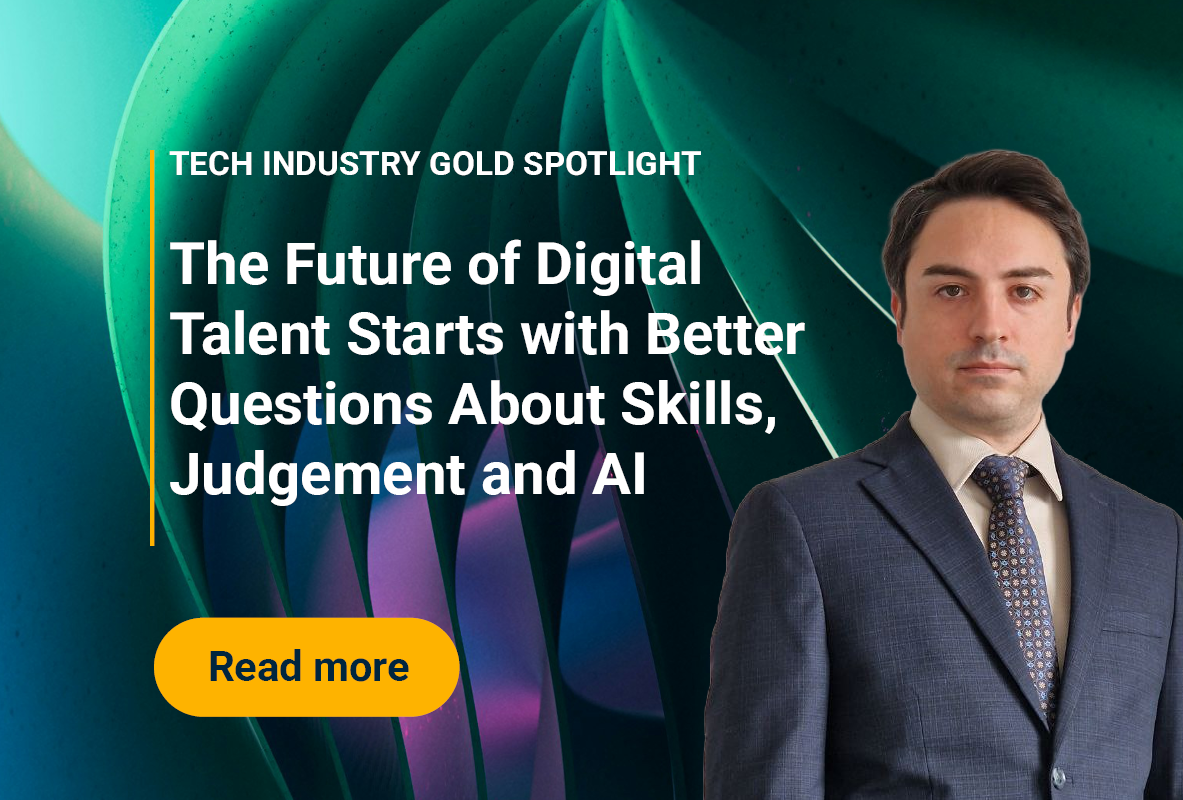
As Associate Professor in Computer Science and Digital Technologies, Apprenticeship Lead within the School of Architecture, Computing and Engineering, and Course Leader for the University of East London's Tech Industry Gold-accredited Digital and Technology Solutions Professional (DTSP) apprenticeship programmes, his work is centred on a simple but increasingly important challenge: how can technology be used to create meaningful outcomes for individuals, organisations and society?
That question has shaped a career spanning internationally recognised research, industry collaboration and award-winning teaching. Alongside leading apprenticeship programmes designed in partnership with employers, Dr Mohammad's research has explored the practical application of artificial intelligence across areas including psychology, behavioural science, healthcare, business, and organisational decision-making, helping bridge the gap between academic innovation and real-world impact.
Today, his work reflects many of the principles underpinning Tech Industry Gold accreditation: industry relevance, employer engagement and a commitment to ensuring learners develop the skills needed to thrive in an evolving digital economy.
"AI is most powerful when it moves beyond automation and becomes a tool for understanding, supporting and empowering people."
That philosophy has become a defining theme throughout both his research and educational leadership.
Applying AI to Real-World Challenges
Whilst artificial intelligence continues to dominate headlines, much of Dr Mohammad's work focuses on something more practical: how intelligent technologies can solve meaningful problems and improve outcomes for people.
His research portfolio spans healthcare, psychology, organisational performance, cybersecurity, education and animal behaviour science, exploring how machine learning and data-driven approaches can support better decision-making across diverse sectors.
One of his most widely recognised projects explored the use of AI-powered patient education within eye care. The research examined how intelligent systems could help patients better understand complex medical information, particularly when navigating stressful and time-sensitive conditions such as retinal detachment. The work attracted significant international media attention and demonstrated how AI could be used to improve communication, accessibility and patient understanding without replacing clinical expertise.
His research has also extended into the field of animal behaviour science. In a study published in Scientific Reports, Dr Mohammad applied machine learning techniques to large-scale canine behavioural datasets to identify distinct personality types in dogs, helping establish a data-driven framework for understanding complex behavioural patterns. In further research published inApplied Animal Behaviour Science, he explored how machine learning and deep learning models could help predict assistance dog training success, supporting evidence-based decision-making, more effective training pathways and improved welfare outcomes for dogs and the people who rely upon them.
Across healthcare, behavioural science, education and organisational performance, a consistent theme emerges: using technology responsibly to create practical and measurable benefits.
More recently, his research into AI-enhanced personality assessment demonstrated over 93% accuracy in predicting personality traits. Whilst such technology could have applications in coaching, leadership development, wellbeing and workforce development, Dr Mohammad believes its greatest value lies in supporting understanding rather than replacing human judgement."The future will not simply be about AI capability. It will be about AI responsibility."
Closing the Distance Between Learning and Work
Alongside his research, Dr Mohammad has become a leading figure in digital apprenticeship education.
Since joining the University of East London in 2020, he has helped shape apprenticeship provision that combines academic rigour with workplace relevance, supporting learners as they develop technical expertise alongside professional skills and industry experience.
For him, the appeal of apprenticeships lies in their ability to create an immediate connection between learning and impact.
Unlike traditional educational routes, apprentices are able to apply new knowledge directly within their organisations, strengthening both their learning experience and their contribution to the workplace.
"Apprenticeships are one of the most powerful mechanisms for closing the gap between education and employment in the digital sector."
This approach has helped establish the University of East London as a recognised leader in apprenticeship delivery. The institution recently received the AAC National Apprenticeship High Commendation Award for Digital Apprenticeship Provider of the Year, recognising the collective efforts of staff, employers and apprentices in creating a high-quality learning experience.
The university's Tech Industry Gold-accredited Digital and Technology Solutions Professional programmes further reflect this commitment to industry-aligned education. Accredited by techskills, the employer-led accreditation recognises programmes that demonstrate strong employer engagement, industry relevance and a focus on developing work-ready digital talent. It also provides an important mechanism for ensuring that curriculum design and learner outcomes remain aligned with the evolving needs of the technology sector.
The Challenge of Staying Relevant
Throughout his career, Dr Mohammad has worked closely with employers, healthcare organisations, public sector bodies, police services and industry partners. These experiences have reinforced a belief that meaningful collaboration between universities and employers is essential if education is to remain relevant in a rapidly evolving digital economy.
In practice, this means involving employers throughout programme design, review and continuous improvement rather than treating industry engagement as an afterthought.
Employers provide insight into emerging skills requirements, workplace challenges and future workforce needs. Universities contribute academic rigour, critical thinking and research-informed teaching. Together, they create programmes that prepare learners not only for today's technologies, but for tomorrow's challenges.
This philosophy is reflected throughout the University of East London's Tech Industry Gold-accredited DTSP programmes, where employer feedback, industry insight and continuous improvement help shape both curriculum and learner experience. The accreditation process itself provides opportunities for employers and academic teams to collaborate, helping ensure programmes remain relevant to current and future workforce needs.
For Dr Mohammad, employer-led accreditation provides far more than external recognition; it is about accountability.
"Employer-led accreditation brings credibility, relevance and confidence."
It creates opportunities for meaningful challenge, bringing employer perspectives directly into discussions around curriculum design, learner outcomes and future skills needs. Rather than relying on assumptions about what industry wants, learning providers are encouraged to test, refine and continuously improve their programmes through ongoing employer engagement. The result is learning that remains relevant, responsive and closely connected to the realities of the workplace.
Preparing Learners for an AI-Enabled Future
As AI becomes more capable, human judgement becomes more important. Dr Mohammad believes universities have an important role to play in helping learners develop not only technical competence, but the judgement needed to apply technology responsibly.
Strong foundations in programming, software engineering, cybersecurity and data analysis remain essential. However, employers are increasingly seeking professionals who can think critically, communicate effectively, adapt to change and understand the ethical implications of emerging technologies.
These are also the capabilities increasingly recognised through Tech Industry Gold accreditation, where technical knowledge is considered alongside professional behaviours, industry awareness and workplace readiness. For programmes such as UEL's DTSP provision, this helps ensure learners are prepared not only for their first role, but for long-term progression within the digital economy.
One capability, in particular, stands out.
"In the age of AI, one of the most important skills is judgement."
The digital professionals who succeed will not simply be those who understand how to use AI tools, but those who understand when to question outputs, how to assess risk and how to make responsible decisions in increasingly complex environments.
Seeing What’s Possible
Dr Mohammad's contributions have been recognised through multiple awards for innovative teaching, impactful research, leadership and student experience. He has also been recognised as one of the most influential Data Science Innovators by CIO Leaders Magazine and among the top five changemakers defining the future of innovation by Magnate View Magazine.
Yet for him, the most meaningful measure of success is not found in awards or accolades.
The moments that matter most are seeing learners grow in confidence, progress in their careers and achieve things they once thought were beyond their reach.
"A truly impactful learning experience is one that changes what learners believe they are capable of achieving."
That philosophy underpins both his work at the University of East London and many of the principles that sit at the heart of Tech Industry Gold accreditation. Technical expertise remains essential, but long-term success increasingly depends on curiosity, adaptability, critical thinking and the ability to apply knowledge in real-world environments.
Throughout his research, industry engagement and leadership of UEL's Tech Industry Gold-accredited DTSP programmes, a consistent theme emerges: technology delivers its greatest value when it empowers people to learn, grow and make better decisions.
As the digital economy continues to evolve, organisations will need professionals who can do more than understand technology. They will need individuals who can exercise sound judgement, navigate complexity and apply their skills with confidence and purpose.
For Dr Mohammad, preparing future digital talent is not simply about helping learners keep pace with change. It is about equipping them to contribute to it.
Find Out More
Interested in exploring Dr Mohammad's work?
Dr Mohammad's research explores the responsible application of artificial intelligence across healthcare, behavioural science, organisational performance and digital education, with a particular focus on how technology can be used to create meaningful outcomes for individuals and organisations.
Learn more about Dr Mohammad's research, publications and professional profile.
To learn more about the University of East London's Tech Industry Gold-accredited Digital and Technology Solutions Professional (DTSP) apprenticeship programmes, visit the University of East London's website.
Interested in how employer-led accreditation helps ensure learning remains aligned with industry needs?
Tech Industry Gold accreditation brings employers and educators together to help shape programmes that reflect current and future workforce requirements, supporting the development of work-ready digital talent across the UK.
Find out more about Tech Industry Gold accreditation and explore accredited programmes. Contact ian.bolton@techskills.org