
Zoltan Vass on AI, Business Strategy and Transformation
Zoltan Vass on AI, Business Strategy, and Transformation
Foreword
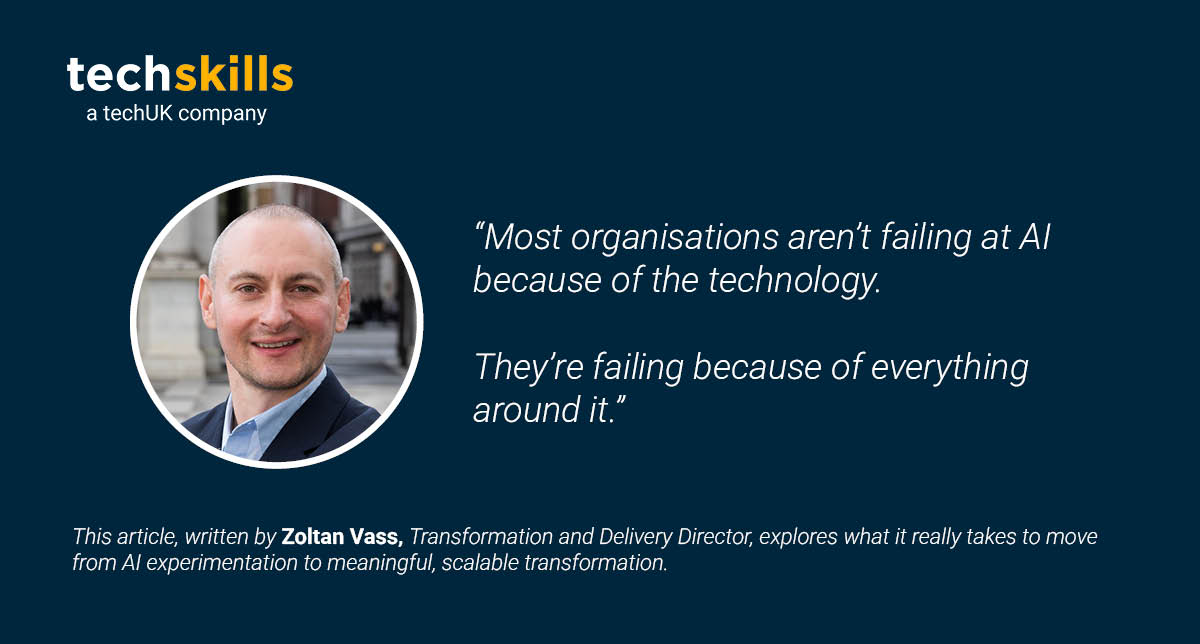
This article has been written by Zoltan Vass following a recent techskills enrichment activity delivered in partnership with Queen Mary University of London
As part of the techskills employer network, Zoltan delivered an insight talk on AI, Business Strategy and Transformation, moderated by Ian Bolton. The session was delivered for learners studying on Tech Industry Gold accredited programmes at Queen Mary University of London, forming part of techskills’ wider employer-led enrichment model.
The session saw strong engagement from learners, with thoughtful questions and discussion throughout. This article captures key themes explored during the session and continues the conversation beyond the room, offering a practical, employer-led perspective on how organisations are approaching AI transformation today.All questions and responses that follow are authored by Zoltan Vass and reflect his personal insights, professional experience, and delivery of the session.
Context
The session was organised by techskills in collaboration with Queen Mary University of London, bringing together learners, academics and industry expertise to explore the role of AI in business strategy and transformation.
techskills is part of techUK, the UK’s largest technology trade association, representing over 1,300 member companies. As a not-for-profit organisation and a fully ratified PSRB, techskills is the accreditation body for Tech Industry Gold, the UK’s only employer led tech accreditation.
Working with learning providers and employers, techskills accredits a broad range of provision, from short courses and bootcamps to apprenticeships, degree apprenticeships, and undergraduate and postgraduate programmes.
This long-standing partnership with Queen Mary University of London reflects a shared commitment to high quality, industry aligned education. Queen Mary has delivered degree apprenticeships since 2015, becoming the first Russell Group university to do so, and most recently achieved an Ofsted Outstanding rating for its apprenticeship provision.
Through its employer network, techskills delivers enrichment activities such as insight talks, workshops and industry panels, connecting learners on Tech Industry Gold accredited programmes with real world industry perspectives.
The session aimed to help learners understand how organisations approach AI strategically, not just as a technology, but as a driver of business goals, decision making and organisational change, and how this translates into real roles and responsibilities.
About the speaker
Zoltan Vass is a global transformation and technology leader with 19 years of experience driving enterprise product, software engineering, and digital transformation across B2B SaaS environments. His recent work focuses on enterprise AI transformation and adoption, developing operating models, governance frameworks, and practical implementation approaches that enable organisations to adopt AI safely and effectively.
Zoltan holds CPD certifications as an AI Professional from the University of Oxford, achieving 100% in the How to Drive AI in Your Business module. He has also been recognised as one of the British Interactive Media Association’s (BIMA) Top 100 Most Influential People in Digital (Tech Trailblazer).
You can learn more at:
In conversation with learners: Questions answered by Zoltan Vass
This piece reflects on a highly engaging session on AI, business strategy, and transformation, and aims to continue the conversation beyond the room. It brings together key themes explored during the session, from aligning AI to existing business strategy, to recognising that AI transformation is ultimately a change journey centred on people, supported by governance, technology, and structured implementation.
More than anything, it aims to provoke discussion and encourage a practical, grounded view of what effective AI transformation looks like, and the discipline required to execute it successfully.
1. Why does AI strategy need to be aligned with the existing business strategy?
For me, this is the starting point. AI strategy cannot sit alongside the business strategy as a separate track. It has to be tied directly to what the organisation is already trying to achieve, whether that is growth, productivity, operational efficiency, better decision-making, stronger customer or student experience, or new revenue streams. If it is not aligned, it becomes detached, siloed and difficult to scale.
That view comes from years of leading transformation across product, engineering, SaaS, retail, e-commerce and regulated environments. I started in infrastructure, building servers and networks, and then moved into enterprise software and large-scale change. One thing I have learned very clearly is that technology only creates value when it is connected to a real business objective. Otherwise, you end up with activity but not impact.2. What does good AI-enabled transformation look like, and how can organisations set themselves up for success?
Good transformation is structured, outcome-led and practical. It is not about launching a tool and hoping people work it out. In my work, the most effective approach starts with understanding the business as it is today, the ambition over the next 6 to 12 months, the problems worth solving, and whether AI is genuinely the right answer.
That is why I use a three-stage framework.
First, a workshop phase to align the AI agenda to the business strategy, define use cases, set KPIs and ROI, and build a client-side Centre of Excellence.
Second, a pilot and upskilling phase to test the use case in a controlled way, with the right compliance, security and governance in place.
Third, scale and capability building, where proven wins are rolled out with playbooks, coaching and a repeatable operating model.
That is how AI becomes a business capability rather than a one-off experiment.3. In your experience, what do organisations most often miss when they start an AI transformation?
The biggest thing they miss is the transformation process itself. Too many organisations still treat AI as though it is just another tool. They buy access, run a few experiments and assume the rest will follow. But without a proper process and upskilling, what looks like innovation can quickly become confusion and chaos.
What tends to be missing is clear ownership, governance, upskilling, role clarity, data discipline and strong communication from the top. I have seen throughout my career that transformation stalls when people do not understand why the change is happening, how the technology should be used, or what the boundaries are. That is where you start seeing the familiar problems, from poor adoption to security risks and uncontrolled use of sensitive information.4. How important are guardrails in AI adoption, and who should take responsibility for them?
Guardrails are essential. They are not there to slow innovation down; they are what make innovation usable, trustworthy and scalable. In practice, that means clear rules around data access, security, privacy, human oversight, auditability, escalation paths and accountability.
Organisations need to take primary responsibility themselves. External guidance and regulation are important, but they are not enough on their own. Boards, leadership teams and delivery teams all need to understand the implications of AI in their own environment and put the right controls in place. In my work, especially with private equity, financial services and product-led businesses, I see governance as part of the operating model, not a compliance exercise bolted on at the end.5. Do regulators currently have the knowledge and speed to govern AI effectively?
Regulation is still catching up, and in some areas, it is inevitably reactive. Technology is moving faster than most institutions can respond to. That said, the core principles are not new. Privacy, accountability, transparency, human oversight, traceability and ethical use are all things organisations should already be taking seriously, whether regulation is perfectly formed yet or not.
My view is that businesses should not wait for perfect regulation before acting responsibly. In my background, I have worked in environments where GDPR, PCI DSS, delivery governance and data risk management were critical. That experience shapes how I see AI as well. The organisations that move well are the ones that combine ambition with discipline and build trust into the system from the start.6. Where do you think organisations really are on AI adoption today, and how do you bring reluctant people with you?
Most organisations are still early. There is a lot of interest and experimentation, but much less mature adoption. Many teams are using tools in isolated ways, but they have not yet embedded AI into day-to-day workflows in a governed, repeatable way.
To bring people with you, you have to make it real. You need to show where AI helps in practical terms, explain how it works, be honest about the risks, and invest in upskilling. Change is always about people first. Across my career, I have built and led global teams of 50 to 300+ people and founded a Future of Work community of more than 700 members. That has reinforced my belief that people adopt change when they feel clear, supported and involved, not when technology is simply pushed at them.7. Can you share an example of AI strategy working well in practice?
One practical example is a proof of concept for a private equity context. Investment teams receive large volumes of pitch decks and spend too much time extracting the same information in different formats. The use case was to build an agent that pulls the relevant information from the pitch deck and populates it into a standard template automatically.
I like this example because it is simple, measurable and directly linked to business value. It reduces friction, improves consistency and supports faster decision-making. That is what good AI strategy looks like to me: not theatre, but clear alignment between the business problem, the operating model, the governance and the outcome. More broadly, my career has centred on that same principle: tying transformation to measurable results, whether that meant delivering a £1m programme on time and on budget, or reducing operational idle time to zero.8. What is the next big shift in AI and business strategy?
The next shift is towards more agentic ways of working and more proactive digital labour, but I do not think the real issue is the technology itself.
The real issue is whether organisations have laid the foundations to use it properly.
We are moving towards hybrid models where humans and AI agents work together more closely, and where organisations become more outcome focused. But before businesses rush there, they need to get the basics right: strategy alignment, governance, upskilling, clear ownership and trust between people and technology.
In my view, that trust between people, governance and technology is the real bottleneck to adoption and growth.
Speaker and partner reflections**Zoltan Vass, Transformation and Delivery Director****
“It was a real pleasure speaking with the Queen Mary University of London students about AI, business strategy, and transformation. They asked thoughtful, insightful questions throughout, and Ian Bolton did an excellent job of guiding the discussion so naturally and effectively. I thoroughly enjoyed the session and hope the students came away with a clearer understanding of where AI strategy sits within a broader business context, what effective AI transformation looks like in practice, and the key factors organisations need to consider to make AI transformation and delivery successful.”
Ian Bolton, Academic Director – techskills “We are always delighted to support our providers by facilitating passionate and informative guest speakers to work with apprentices and learners. Zoltan delivered a talk that balanced insight into best practice with real-world examples, prompting excellent discussion and thoughtful questions from both learners and faculty.”
Rachel Appleton, Deputy Dean for Education, Faculty of Science and Engineering, Queen Mary University of London “This session highlighted the real value of our long-standing partnership with techskills and the benefits their industry connections bring to our students and apprentices. Their ability to introduce experienced guest speakers into our teaching creates opportunities for learners to engage directly with current thinking and real organisational practice. Zoltan’s contribution reflected this particularly well, helping students understand how AI fits within a wider business strategy, alongside the importance of people, culture and governance in transformation.”
Acknowledgement
Thank you to everyone who contributed their insights, experiences and perspectives to this session. Bringing together practical knowledge from across organisations and disciplines is what makes conversations like this genuinely valuable.
A special thank you to Zoltan for his contribution and reflections, helping to translate complex ideas into something clear, relevant and actionable for those navigating their own AI journey.
This session forms part of techskills’ ongoing employer-led enrichment, supporting learners on Tech Industry Gold accredited programmes to connect with real-world industry practice.
Explore Queen Mary University London’s Tech Industry Gold accredited programmes:
Digital and Technology Solutions (Software Engineering)
Digital and Technology Solutions (Business Analyst)